Remember Me As You Pass By… A Favorite Epitaph
Fifteenth in a series of Occasional Papers about Eastern Cemetery in Portland, Maine
by Ron Romano
© November 2026
Figure 0. Inscription for Enoch Littlefield (full image of marker in Figure 1)
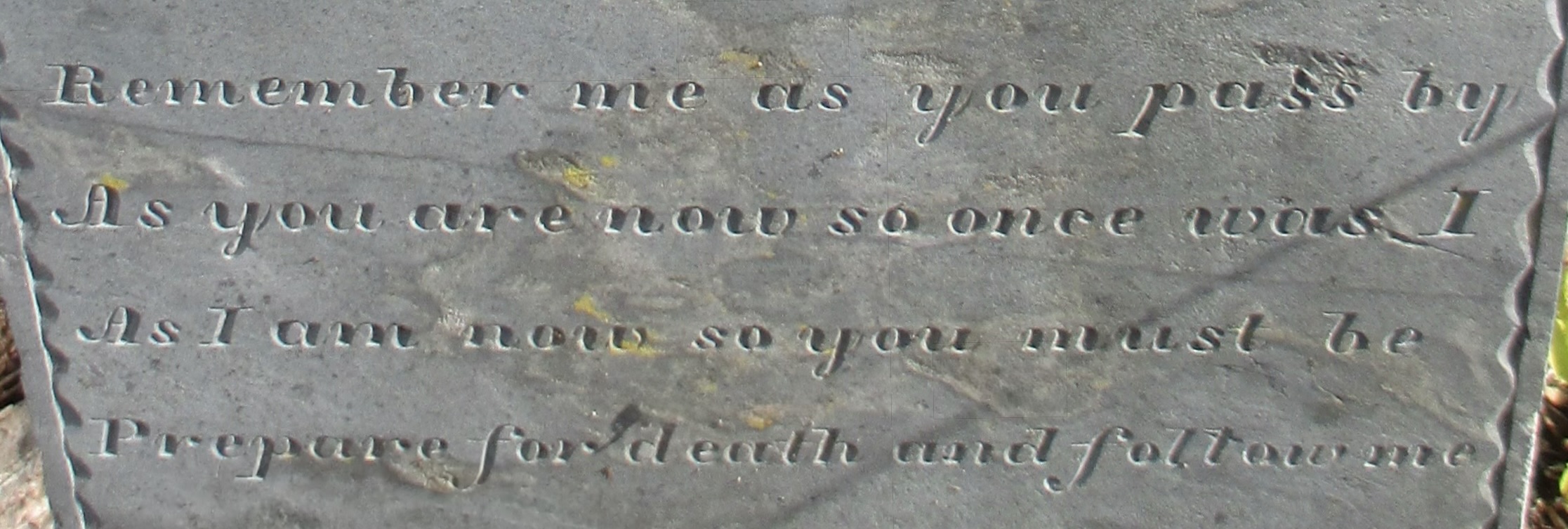
- Remember me as you pass by
As you are now so once was I
As I am now so you must be
Prepare for death and follow me
Ask any gravestone enthusiast about a memorable epitaph they’ve found on an old slate or marble marker and you’ll mostly like hear a version of the verse that’s shown on the title page of this paper. In most of its forms it is a whimsical poem, but the underlying message is quite sincere. It served as a reminder to all those living that death is our fate. This verse has deep roots, and it is widely found on stones throughout Maine. Portland’s Eastern Cemetery holds at least six of them, though certainly there were more before neglect, vandalism, and mass migration to other cemeteries significantly reduced the number of original grave markers. This paper examines the epitaph that’s a favorite verse for so many.
Contents
- The Basic Verse
- Roots
- Early Examples in Maine
- Eastern Cemetery's "Remember me…" Markers
- Lucy (Stone) Pierce, 1802
- Chloe (Bradford) Starboard/Starbird, 1822
- Margaret Wiswell, 1823
- John Holland, 1837
- Martha Hatch, 1838
- Capt. Joshua Freeman, 1840
- Later Examples
- The Wrap-up
- References
- Appendix
The Basic Verse
There are many versions of the four-line rhyming epitaph that’s the subject of this paper. Stonecutters and marble workers altered the verse as they—and perhaps families purchasing stones from them—wished, but our starting point is this one:
Remember me as you pass by,
As you are now so once was I.
As I am now so you must be,
Prepare for death and follow me.
This particular version is perfectly rhymed, has a pleasing cadence, and today brings a smile to our faces. Two hundred years ago when the verse was in popular use, the reaction from passersby might have been different. It is, after all, a version of memento mori, Latin for “remember you must die.” Though the verse was not necessarily meant to invoke feelings of doom and gloom, it may have had that effect on some. The intention of memento mori—words that themselves are sometimes found carved on eighteenth-century gravestones1—was to encourage people to focus on making their lives on earth the best they could possibly be.
Figure 1: Marker for Enoch Littlefield, 1836, at the Littlefield Cemetery (a private cemetery) on Chebeague Island. Courtesy of the author.
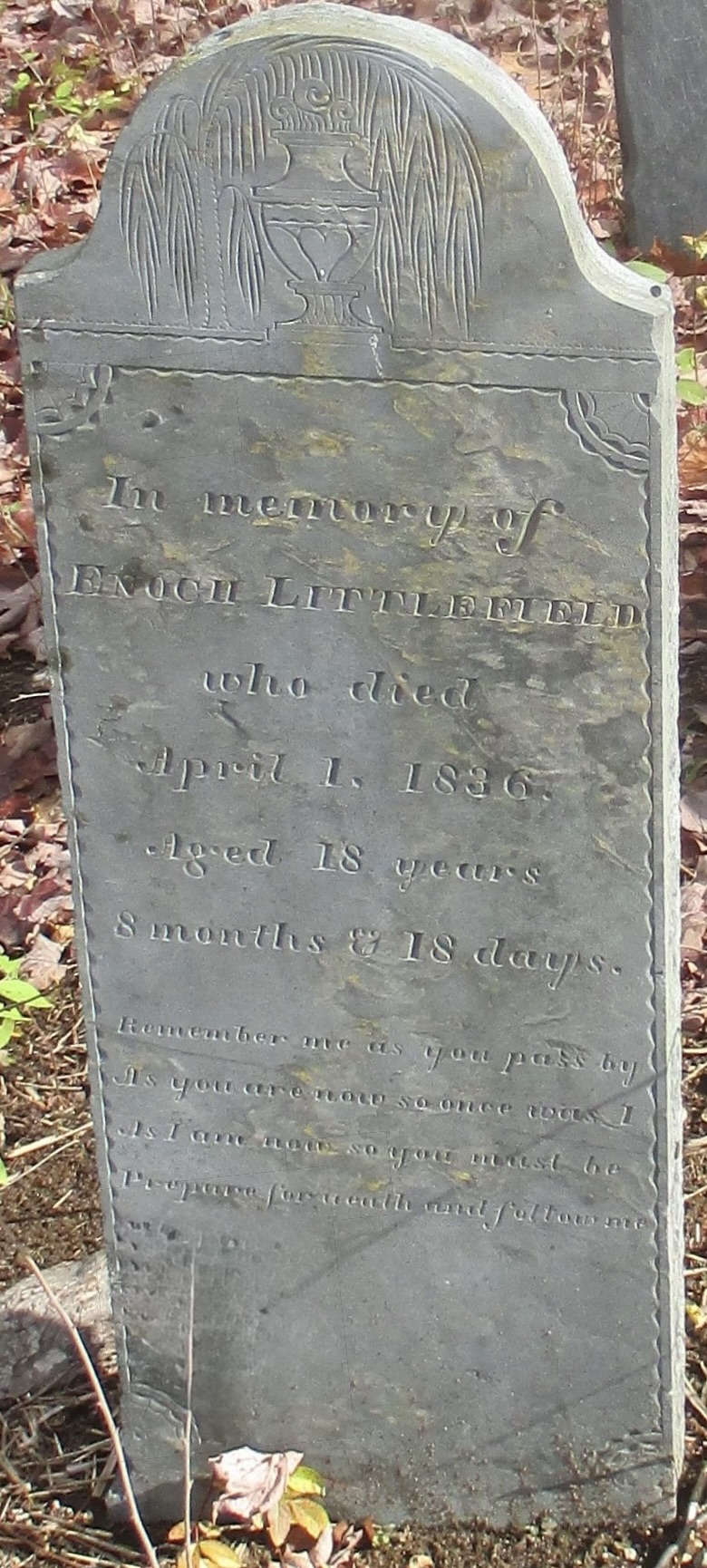
- In memory of
ENOCH LITTLEFIELD
who died
April 1, 1836.
Aged 18 years.
8 months & 18 days.
Remember me as you pass by
As you are now so once was I
As I am now so you must be
Prepare for death and follow me
Roots
The verse was brought to New England from old England. In his 1963 book, English Churchyard Memorials, researcher Frederick Burgess wrote that “It is probably no accident that [the theme of mortality] became prominent in the fourteenth century, when the Black Death took such a heavy toll on life, and tomb-makers introduced… the most prevalent of epitaphs: As you are now; so once was I; As I am now; so you must be; Therefore prepare to follow me.”2 Two sources noted the English roots of the verse as the Canterbury tomb of Edward, the Black Prince, who died in 1376.3 Edward’s epitaph translates to modern English as:
You that passes by,
Where these corpses entombed lie,
Understand what I shall say,
As at this time speak I may.
Such as you are, sometime was I,
Such as I am, such shall you be.
This means the verse has been in use for over six hundred years! But it likely goes even further back to the Roman Empire. Online searches include a handful of references to verses found in Latin on Roman gravestones. Two versions are:
Sum quod eras, fui quod sis
and
Eram quod es, Eris quod sum
In English, these translate to “I am what you will be, I was what you are” and “You will be what I am.” None of the sources I found making references to the Roman Empire included a photo or citation to a specific grave marker. Still, in his 1865 work, A Collection of Epitaphs… gravestone maker Alpheus Cary included the first of the pair of Latin phrases shown above as an example of a gravestone epitaph.4 Cary has ties to Eastern Cemetery as one of the first men to work in Bartlett Adams’s shop. Cary and Adams trained together in Quincy, Massachusetts. Bartlett came to Portland and opened his shop in 1800; Alpheus arrived in 1806, and worked for a couple of years. When he departed Portland to return to Massachusetts, he left behind at least three dozen markers at Eastern Cemetery. He then enjoyed decades of success as a gravestone maker in Boston.
Alpheus Cary seems to have tapped into a publishing trend that was unfolding across the Atlantic; I’ve found four epitaph books similar to his that were published in Great Britain over a thirty-year period. The first was published in London, a dozen years before Cary’s book, by Joseph Simpson.5 The next is Horatio Edward Norfolk’s 1866 book Gleanings in Graveyards…6 A few examples in Norfolk’s collection hold similarities to the popular verse found on stones in Maine. Of note is one for Thomas Bradshaw in Maidstone, England. He lived to age eighty-two and must have had strong ties to his church. His epitaph reads:
Stop ringers all & cast an eye,
You in your glory, so once was I,
What I have been, as you may see,
Which now is in the belfree [sic]
This verse was recorded by Horatio Norfolk in Barcombe, England:
All you that come my grave to see,
Prepare yourselves to follow me,
Take care Young men, repent in time,
For I was taken in my prime.
Finally from Norfolk’s book is this epitaph from Guildford which seems to poke a bit of fun at the popular verse. It reads:
Reader, pass on, ne’er waste your time
on bad biography and bitter rhyme;
For what I am, this cumb’rous clay insures,
and what I was is no affair of yours.
The third overseas collection of epitaphs was published in 1883 by William Andrews.7 His book does not have a directly matching verse to the one found on gravestones here. But the digitized copy of his book included the handwritten name of its owner, Ada Jervis, and the date she got the book, 1889, on the inside cover. I was also very happy to see that Ada (or someone later) pasted an epitaph onto that same page, shown here (Figure 2).
Figure 2
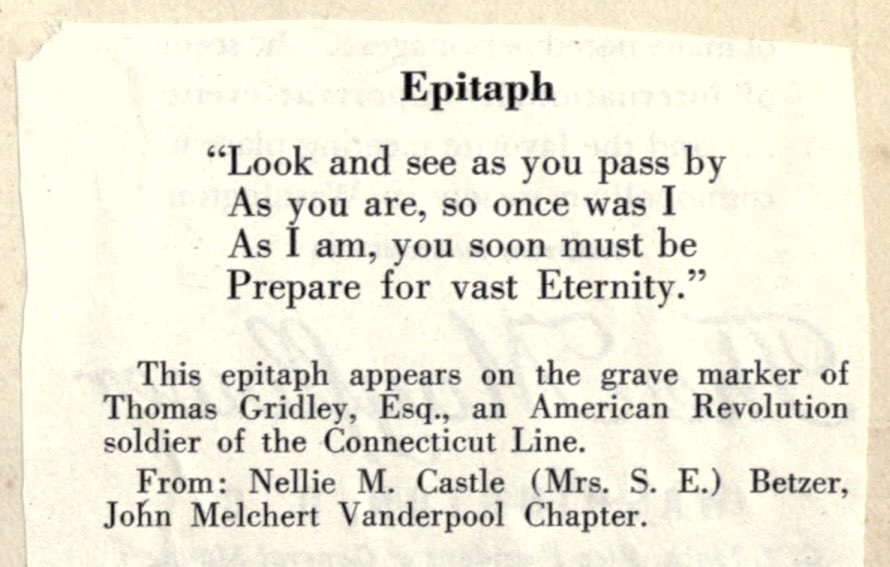
Epitaph
“Look and see as you pass by As you are, so once was I As I am, you soon must be Prepare for vast Eternity.”
This epitaph appears on the grave marker of Thomas Gridley, Esq., an American Revolution soldier of the Connecticut Line.
From: Nellie M. Castle (Mrs. S. E.) Betzer, John Melchert Vanderpool Chapter.
More rabbit holes for me to dive into! Although not critical for this paper, I did look for the Gridley stone and found it to be in Candor, New York. Gridley was indeed a veteran of the Revolutionary War who died in 1846. I also looked for records regarding Mrs. Nellie Betzer and the Vanderpool Chapter to determine an approximate date of when this epitaph might have been pasted into the cover of Ada Jervis’s book. Nellie Castle Betzer was born in the U.S. a dozen years before the book was published. It seems the book came across the Atlantic and the pasting of the epitaph was likely here in the US in the early 1900s.
The fourth epitaph book was published in 1885 in Scotland.8 Though there is no match to the verse we study here, the author Edmund Goldsmid cited an epitaph in a Harford, England, churchyard that ends with the lines, “The end will come as you may see, Do you prepare to follow me.”
Early Examples in Maine
In July, I surveyed the Pioneer Cemetery in Yarmouth to prepare for the production of a video celebrating the 2026 designation of five cemeteries as historic sites in Yarmouth. I was invited to serve as tour guide on the video, providing the history of each site and showing some of the treasures found within their gates. We decided to present the five sites in chronological order, and Pioneer Cemetery—as the name suggests—is the oldest of the five. As I searched the patch for interesting markers, I was delighted to find not one, but two, examples of this verse. I have not found any stones holding this epitaph earlier than these.
The oldest is for two young brothers who died on the same day in 1737! They have a shared slate marker decorated with a pair of winged skulls. Peter Weare was six years old and his brother Daniel was three years old when they died on September 24, 1737. Their marker is shown in my photo (Figure 3).
Figure 3
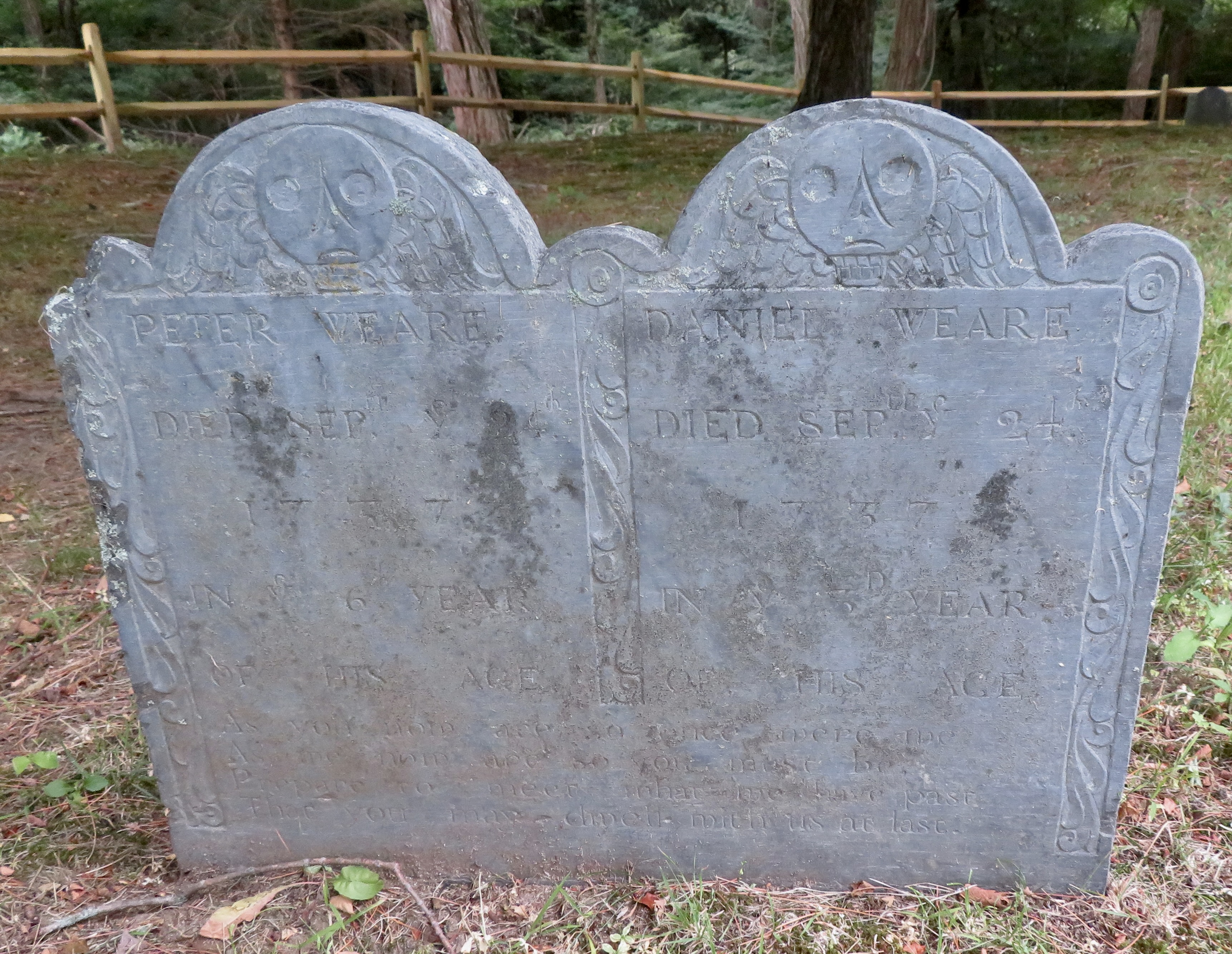
PETER WEARE
DIED SEPt. Ye 24th
1737
IN Ye 6th YEAR
OF HIS AGEDANIEL WEARE
DIED SEPt. Ye 24th
1737
IN Ye 3D YEAR
OF HIS AGEAs you are now, so once were we,
As we are now, so you must be;
Prepare to meet where we have past,
Then you may dwell with us at last.
The epitaph on Peter and Daniel’s marker uses “past” instead of “passed” in the third line of the verse, which reads:
As you are now, so once were we,
As we are now, so you must be;
Prepare to meet where we have past,
Then you may dwell with us at last.
That marker for the little boys is a real treasure, but it’s not the only one at Pioneer. There is a second slate, from 1758 for Reuben Gage, that has a similar verse. Reuben died at the age of thirty-five. Like Peter and Daniel’s stone, his grave marker is from Boston and features the typical design of the period—a winged skull on slate. The epitaph reads:
Behold & see You that pass by
As You are now so once was I
As I am now so You must be
Think upon Eternitye [sic]
Three other Maine markers from the 1700s are known; one for twenty-eight-year-old Freeman Cobb at Hampden’s Old Burying Ground is shown (Figure 4). Freeman died in 1798. His epitaph consists of three lines:
Think on me as you pass by,
As you are now so once was I;
Be wise in Time, Prepare to die.
Figure 4. Freeman Cobb’s marker. Courtesy of Boneyard Reporter, 2018
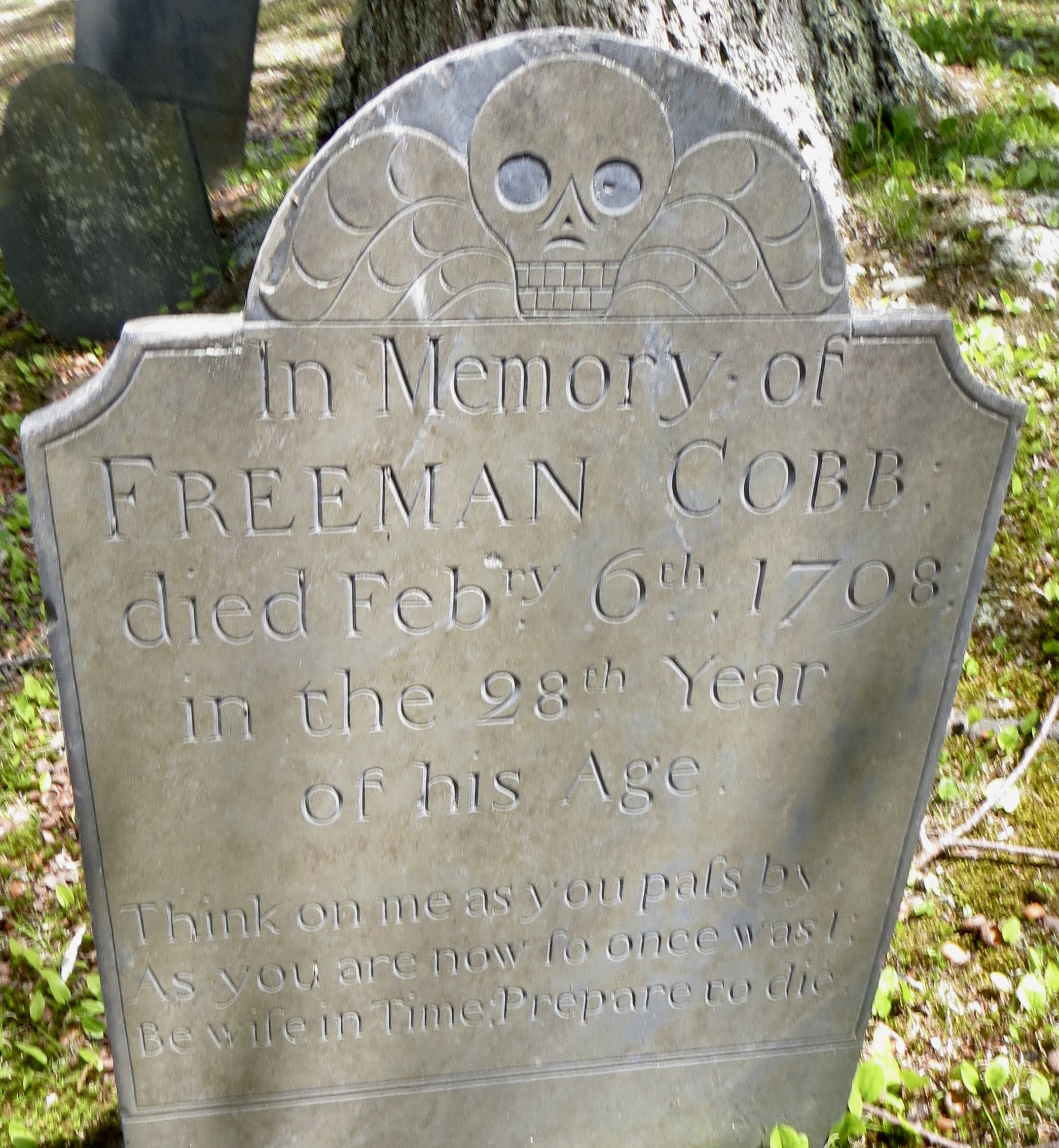
- In Memory of
FREEMAN COBB
Died Febry 6th, 1978;
in the 28th Year
of his Age.
Think on me as you pass by,
As you are now so once was I;
Be wise in Time, Prepare to die.
Another interesting example from the eighteenth century is for thirty-nine-year-old Nathaniel True at Ledge Cemetery in Yarmouth (Figure 5). His marker has a tripartite tympanum, the center arched panel of which is decorated with a simple stylized human soul effigy. The stonecutter is likely Noah Pratt, Jr.
The verse on Nathaniel’s marker reads:
My loving friends as you pass by
On my cold grave pray cast an eye.
Your Sun like mine may set at noon
You may yet be call’d for very soon.
Figure 5. Nathaniel True’s marker dated 1788. Courtesy of Debi Curry
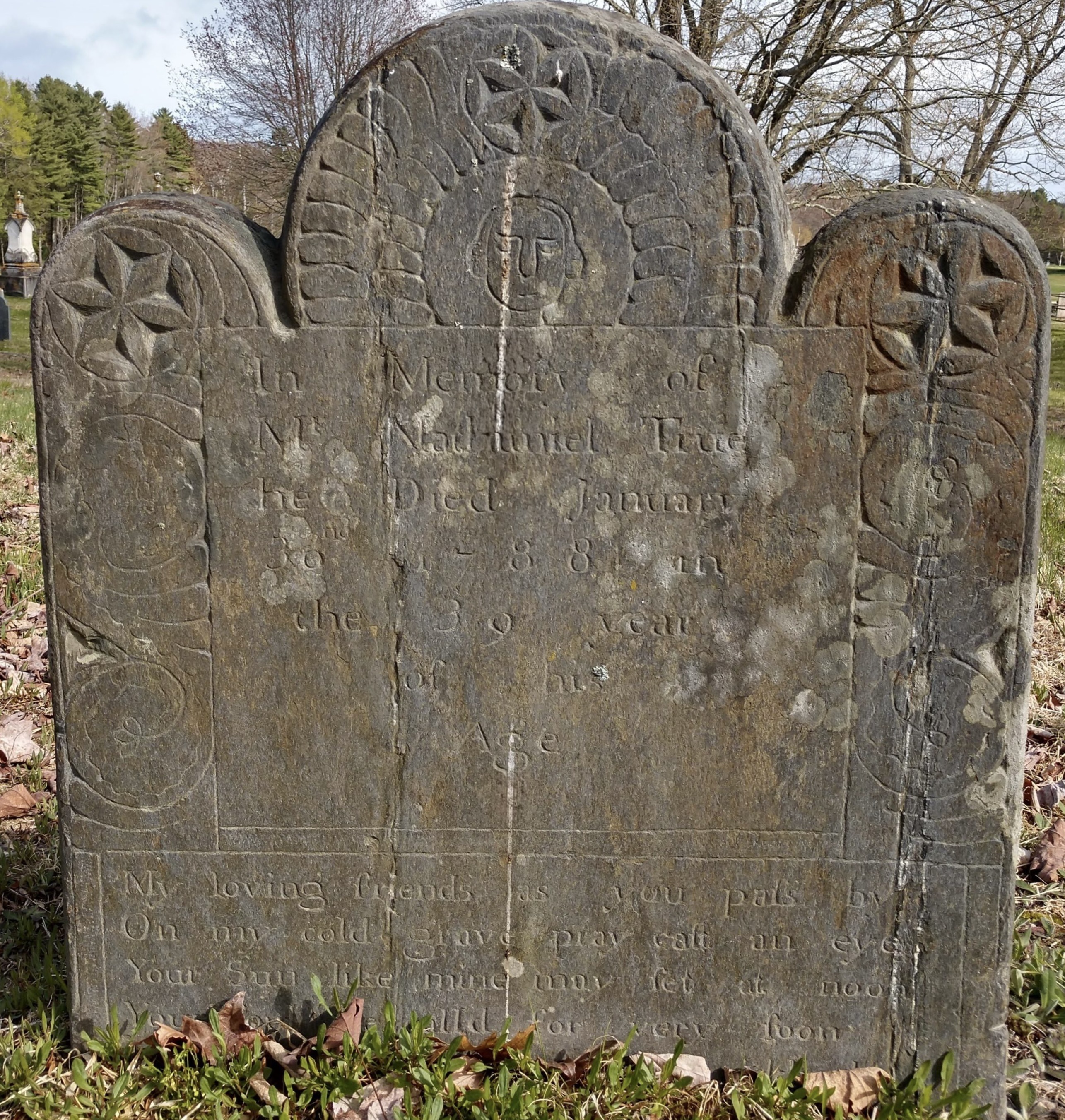
- In Memory of
Mr. Nathaniel True
he died January
30th 1881 in
the 39th year
of his
Age.
My loving friends as you pass by
On my cold grave pray cast an eye.
Your Sun like mine may set at noon
You may yet be call’d for very soon.
For this paper, I cataloged thirty-five markers in Maine featuring the basic verse and all of its variations. Ten counties are so far represented, though I think it is safe to assume we can find this verse in every county. The date span for the collection is 1732 to 1863; The 1830s have the most examples with seven markers. A half-dozen of the thirty-five are marble, all the rest are slate.
Ages of those memorialized range from three to seventy-nine; There are twenty males and sixteen females. The Appendix provides the roster of the thirty-five documented in Maine to date.
Eastern Cemetery’s “Remember me…” Markers
The six surviving markers at Eastern Cemetery are dated between 1802 to 1840. The earliest three were produced in the nearby shop of Bartlett Adams and are from 1802, 1822, and 1823. The final line on the oldest and the final two lines of the 1822 marker are below grade due to the sinking of the stones into the ground. The 1823 marker is just a fragment of the original, but the verse has largely survived on it.
The later three are from 1837, 1838, and 1840. Joseph Thompson had taken over the stone shop with business partner Francis Ilsley soon after Bartlett Adams’s 1828 death. But Ilsley left Maine for New York a few years later, so these three stones were made by Thompson (or possibly someone working with him in the late 1830s). The final three lines of the verses for the markers he produced are identical:
As you are now, so once was I,
As I am now, so you must be,
Prepare for death and follow me.
It’s the first lines that differ:
Remember friends, as you pass by [1836]
Stop my friends as you pass by [1838]
Stop here my friends and cast an eye [1840]
So Thompson seemed to favor using “friends” in his versions of this epitaph. A few other markers in Maine are similar, with “youthful friends,” “young friends,” “blooming friends,” “all my friends,” and “loving friends” found.
Lucy (Stone) Pierce, 1802
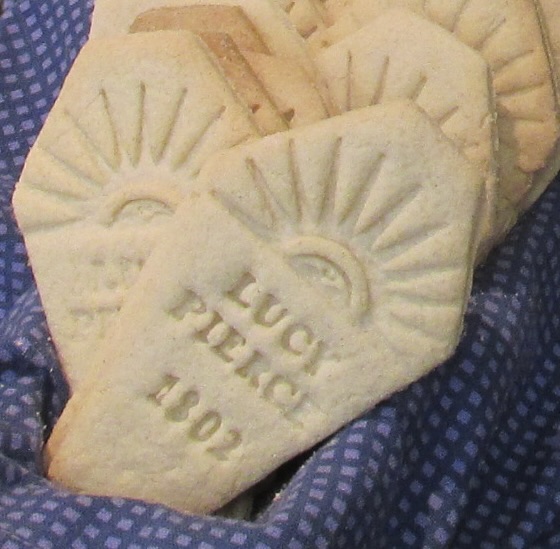
The earliest of Eastern Cemetery’s six markers is for Lucy (Stone) Pierce, who died at the age of twenty-nine in 1802. Her stone at plot H-98 is well known to all of us at Spirits Alive—it adorns the cover of the 2026 edition of our self-guided walking tour map and brochure. It also is the model for a cookie press; many people attending Spirits Alive events have enjoyed a treat that is shaped and decorated like Lucy’s stone (Figure 6)!
Figure 6. Lucy Pierce-inspired cookies, baked by Diane Brakeley. Courtesy of Janet Alexander
I wrote the bio that’s found on her listing on the FindaGrave.com website, which I’ve edited and include here:
Lucy Stone was born in Massachusetts in the Fall of 1772. She married Eli Pierce (sometimes Peirce) in Newton, Massachusetts, in 1796, and within a year delivered their first child, a daughter named Abigail. Around 1800, the family moved to Portland, where Lucy delivered her second (and last) child in July of 1802, a son named Sumner. She died just three months later. Her wonderful slate gravestone featuring a personified rising sun (Figures 7 and 8) was carved by Bartlett Adams. Shortly after Lucy died, Eli remarried (to Betsy White) and had at least one more child. His time and place of death are yet to be discovered.
Figure 7. Art detail of Lucy Pierce’s marker, 1802. Courtesy of C. Mulcahy
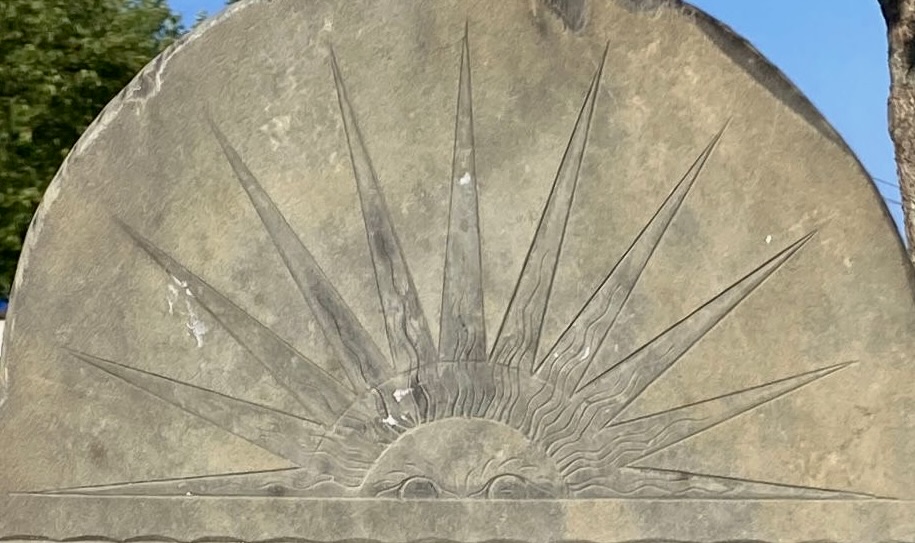
Figure 8. Detail of Lucy Pierce’s marker, 1802. Courtesy of C. Mulcahy
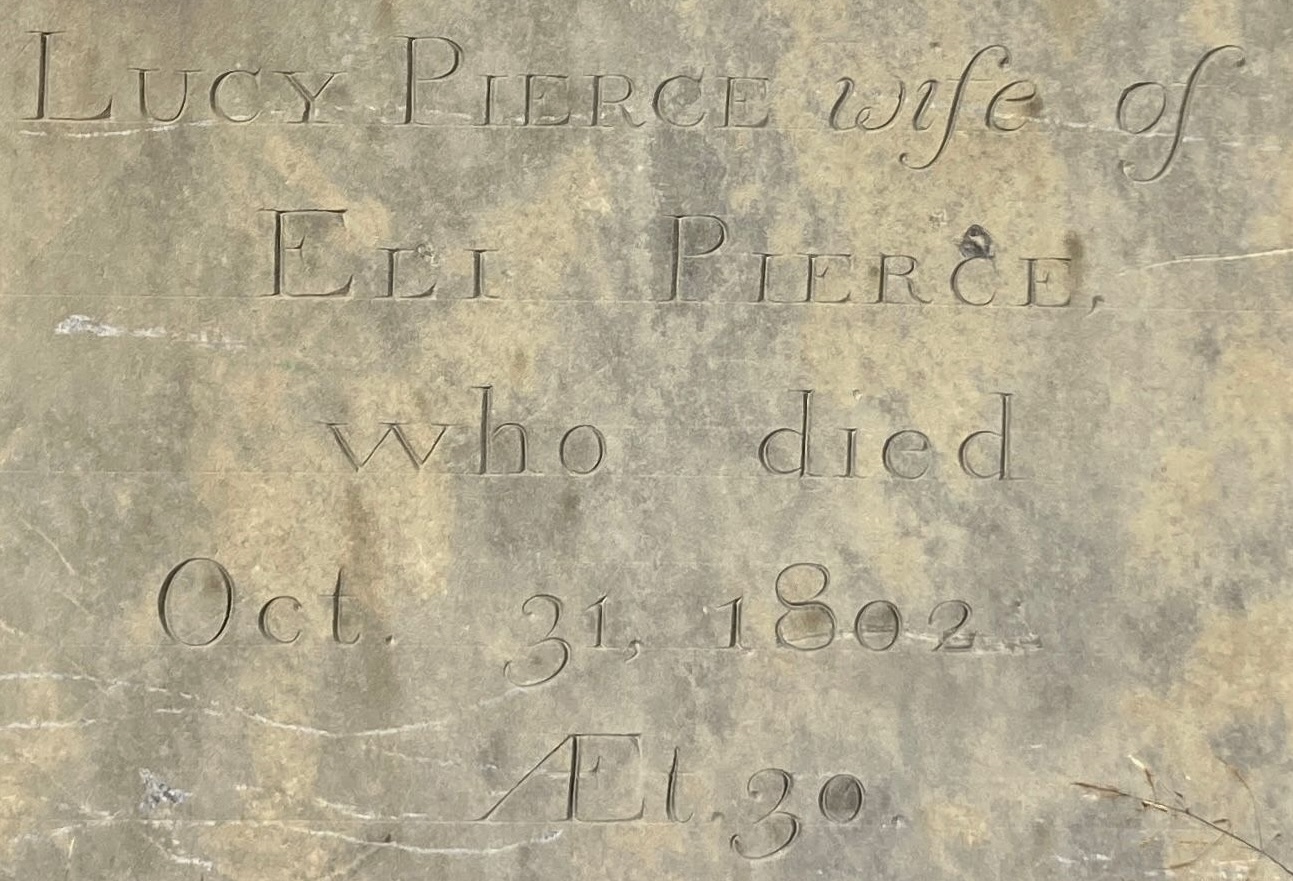
- LUCY PIERCE, wife of
ELI PIERCE,
who died
Oct. 31, 1802
AEt. 30
Chloe (Bradford) Starboard/Starbird, 1822
The stone for Chloe is found at plot K-123. It is a small slate marker that features an urn and willow design from the Adams shop (Figure 9). Although the gravestone spells her name as “Starboard,” most other records use “Starbird.” Her birth year is 1762, birthplace is Providence, and she was fifty-nine when she died in Portland. The newspaper notice of her death noted her to be “consort of Capt. John Starbird.” He is believed to have served during the Revolutionary War. The following is edited from her bio on FindaGrave.com: Chloe was a descendant of Governor William Bradford, one of the first passengers of the Mayflower. She married Portland native John Starbird in Rhode Island in 1780 and they had at least three children.
Figure 9. Slate marker for Chloe Starboard/Starbird. Courtesy of M. Simonds
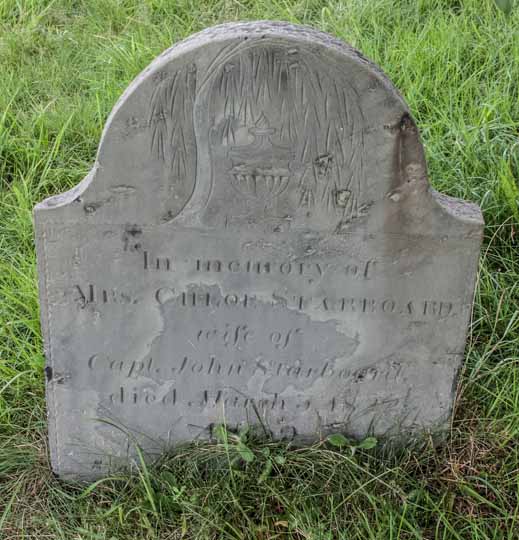
- In memory of
Mrs. CHLOE STARBOARD,
wife of
Capt. John Starboard
died March 5, 1822
AEt. 59
Margaret Wiswell, 1823
Only about sixty percent of the original marker over Margaret Wiswell’s grave at plot I-174 has survived (Figure 10). The lettering is that of Bartlett Adams and includes a slight misspelling of her name as Magaret instead of Margaret. She was eighteen when she died, and the newspaper notices of her death referred to her as “Miss Margaret Wiswell.” The epitaph is fully legible on the marker and a match to the verse on the cover of this paper.
Her family history is not known to me, but I did find a Portland Vital Record of her intention to marry Robert Hanson of Portland (Figure 11). The intention was filed August 11, 1823, but she died just five weeks later, never to become Mrs. Hanson.
I believe Robert married in 1826, and lived a long life with his wife and children.
Figure 10. Fragment of slate marker for Margaret Wiswell. Courtesy of Robert Hall
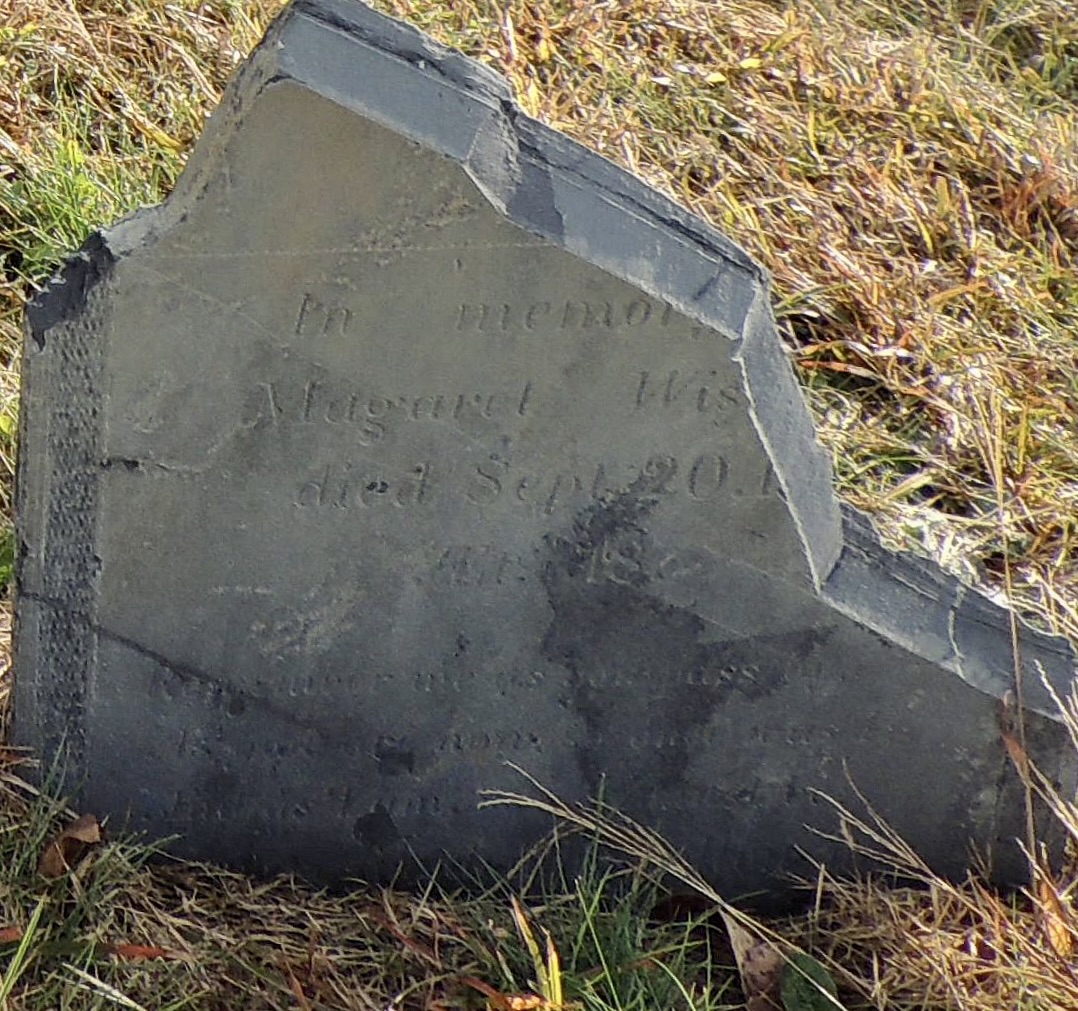
- In memo--
Magaret Wis--
died Sept. 20,--
AEt. 18
Remember me as you pass by,
As you are now so once was I.
As I am now so you must be,
Prepare for death and follow me.
Figure 11. 1823 Marriage intention for Margaret Wiswell and Robert Hanson.
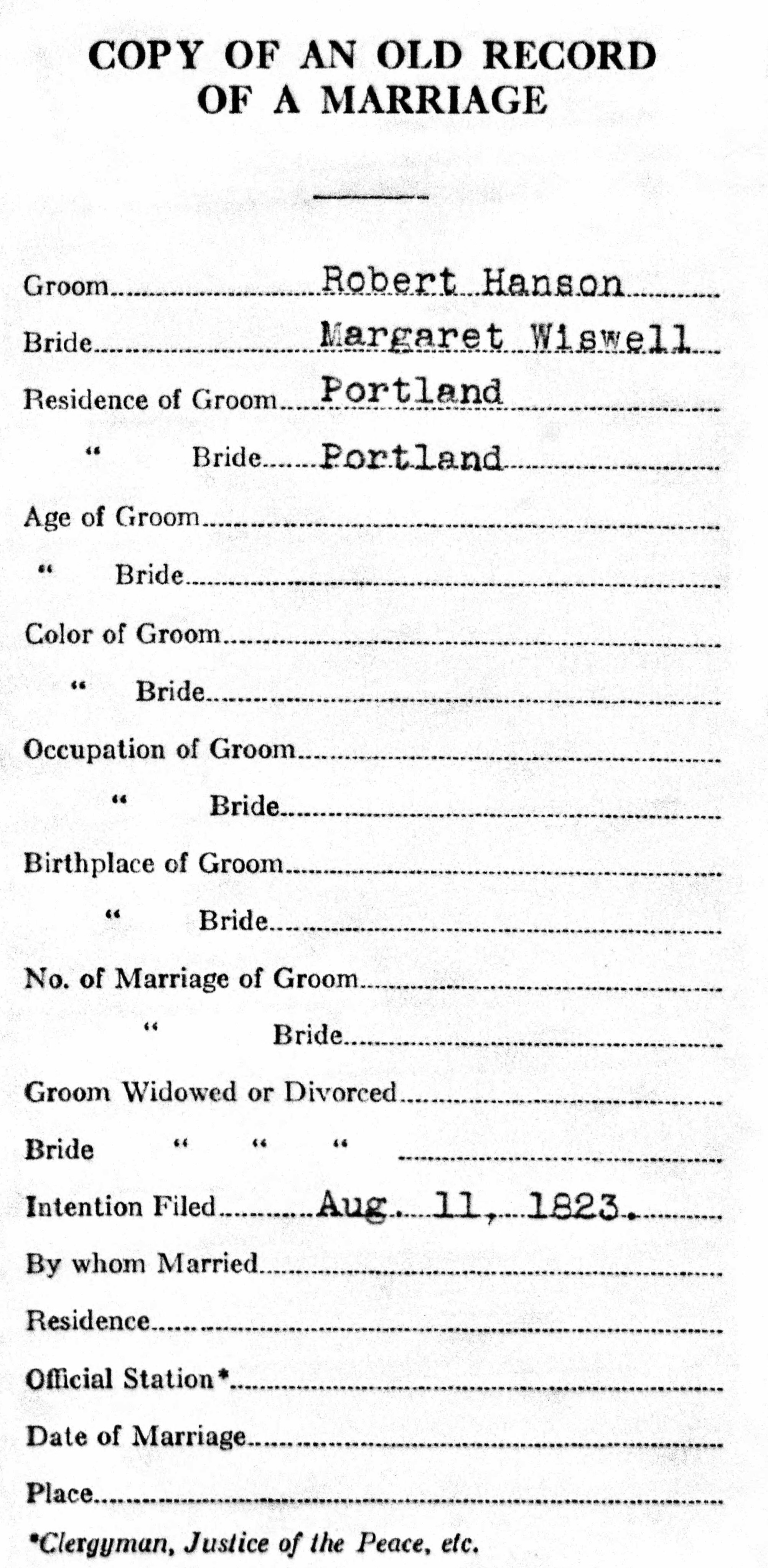
- COPY OF AN OLD RECORD
OF A MARRIAGE
Groom… Robert Hanson
Bride… Margaret Wiswell
Residence of Groom… Portland
Residence of Bride… Portland
Intention Filed… Aug. 11, 1823.
John Holland, 1837
Passing at the age of 37 of consumption (tuberculosis), John Holland was buried in the plot in Section A, row 11, grave 19. His grave is within the newer of two patches at Eastern Cemetery that were designated for people of color. Further, within that small patch is a single row of graves for Black Catholics. John’s grave is there. Adjacent graves hold his wife Mary Ann Syms (who died ten years later) and daughter Julia Ann Holland (who died just two years after John). Both of their stones (in marble) feature Catholic symbolism.
John appeared in the 1830 census for Portland as a “free colored person.” In his household was his wife and daughter. He was not listed in the directories of Portland for 1823 or 1827, since those editions did not include non-Whites. But he did appear in the subsequent three, each time designated as a person of color. In 1831, he was living on Hancock Alley and working as a trader. For 1834, he was a grocer and operator of a boarding house between Hancock and King Streets. The 1837 directory was the same except no mention of a grocery business.
Except for the horizontal scratches at the bottom of John’s slate gravestone—the result of careless groundskeepers using string trimmers—his slate marker is sound and is decorated with the familiar urn and weeping willow (Figure 12). The four-line “Remember me…” verse is easily read.
Figure 12. John Holland’s 1837 gravestone at Eastern Cemetery. Courtesy of the author
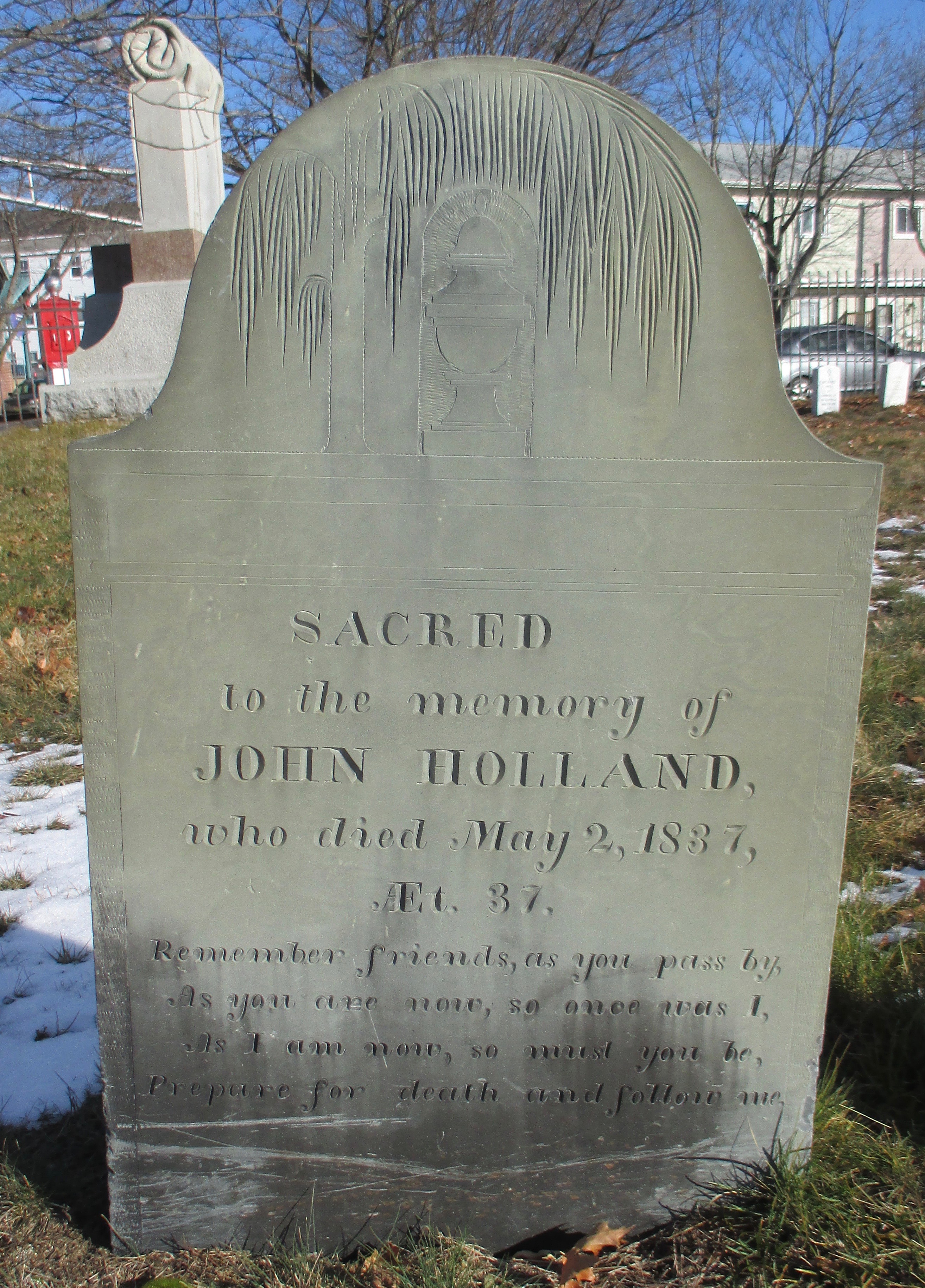
- SACRED
to the memory of
JOHN HOLLAND,
who died May 2, 1837,
AEt.37.
Remember friends, as you pass by,
As you are now, so once was I,
As I am now, so must you be,
Prepare for death and follow me.
Martha Hatch, 1838
Miss Martha Hatch, daughter of Captain Walter and Martha (Capen) Hatch, died on May 21, 1838, at age forty-one. Two siblings died in their infancies and have a shared marker nearby. Martha’s marker was found broken and lying flat on the ground in 2018. The Spirits Alive conservation team went to work to clean and reset it; the photo (Figure 13) was taken shortly after conservation.
Martha appeared in all five Portland directories published between 1823 and 1837, living on her own. In one, she was noted to be a “tailoress.” In most she was referred to as being a widow, yet in her newspaper obituary, the notice of the settlement of her estate, and on her gravestone, she is named as “Miss” and not as a widow (or relict as was otherwise common during this time).
She worked as a milliner (a maker of women’s hats) when she died, according to the published estate notice. A funeral was held at her home on Congress Street near Wilmot Street—just three blocks from the cemetery—also noted in the paper (Figure 14).
The four-line “Remember me…” verse is easily read on her marker, which is located at plot J-186.
Figure 13. Martha Hatch’s stone in 2018 at the time it was cleaned and reset.
Courtesy of Diane Brakeley
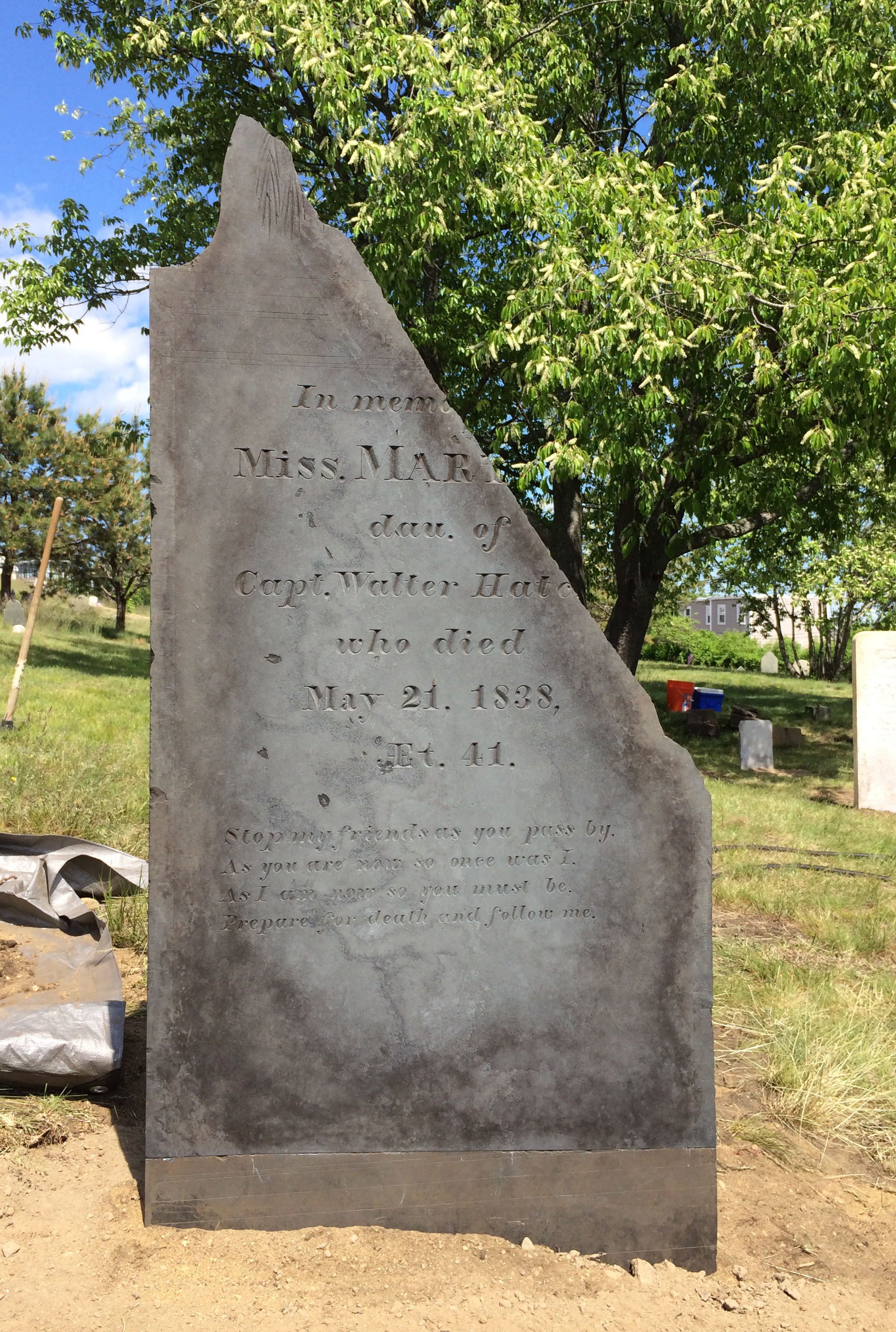
- In mem--
Miss MAR--
dau. of
Capt. Walter Hat--
who died
May 21, 1838,
AEt.41.
Stop my friends as you pass by,
As you are now so once was I.
As I am now so you must be.
Prepare for death and follow me.
Figure 14. May 22, 1838 clipping from the Portland Weekly Advertiser
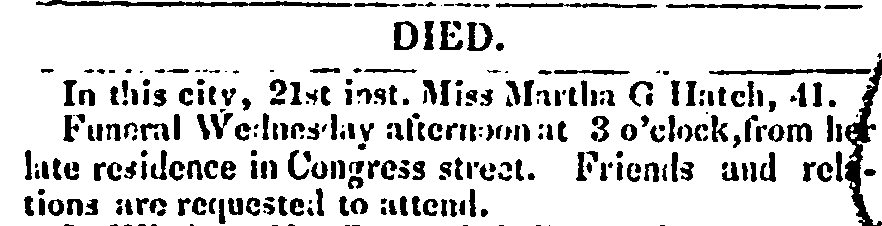
- DIED.
In this city, 21st inst. Miss Martha G. Hatch, 41. Funeral Wednesday afternoon at 3 o’clock, from her late residence in Congress Street. Friends and relations
are requested to attend.
Capt. Joshua Freeman, 1840
The newest of the six “Remember me…” stones at Eastern Cemetery is for Capt. Joshua Freeman, who lived a long life of seventy-six years. His slate marker at plot C-168 features an urn and weeping willow and has survived the ages well. In the newspaper notice of his death, it was reported that he died in Cape Elizabeth and that he had served “for many years keeper of Portland Light.” He married Eliza Elson in 1801. She predeceased him by ten years and her slate marker is immediately beside his. At least nine other members of the Freeman family are in adjoining graves.
Figure 15. Captain Joshua Freeman’s stone. Courtesy of Jackie Gower
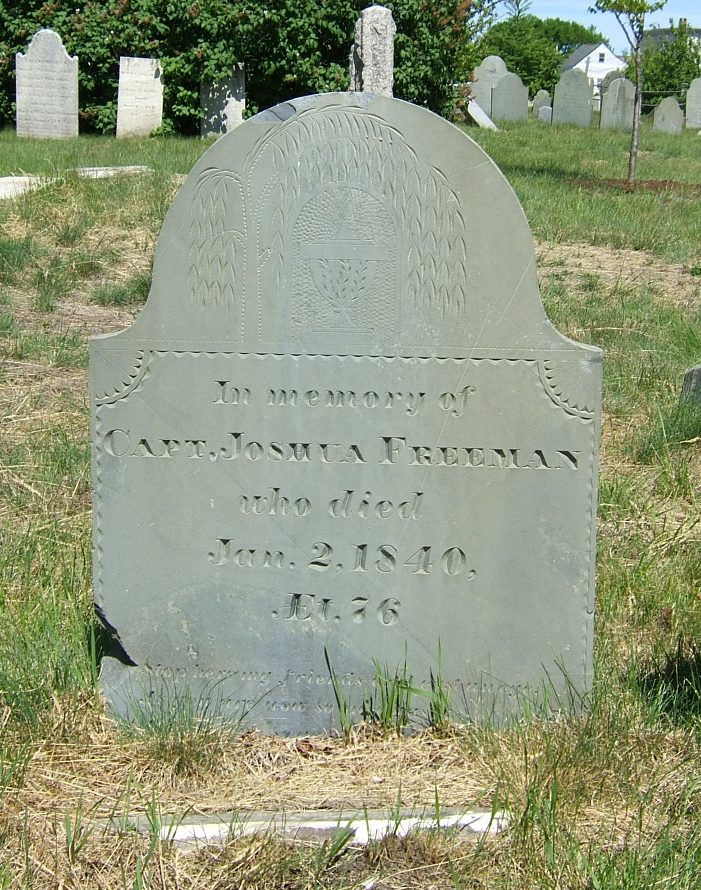
- In memory of
Capt. JOSHUA FREEMAN
who died
Jan. 2, 1840,
AEt.76
Stop here my friends and cast an eye,
As you are now so--
Later Examples
Though Joshua Freeman’s marker from 1840 is the latest one I know of at Eastern Cemetery, seven more examples I’ve documented in Maine were produced after his, from 1842 to 1863. Every decade from the 1770s to 1860s has at least one on the roster (Appendix), so this verse seems to have had staying power. The 1863 stone is at Calvary Cemetery in South Portland and it memorializes James Cassity. He and his brother died three years apart and have identical, very large tablet markers of white marble decorated with a scene of the crucifix and mourners. James’s epitaph reads:
Remember friends as you pass by,
That all mankind are born to die;
Then let your cares on Christ be cast,
That you may dwell with him at last.
The religious bent to this verse is certainly appropriate given that Calvary is the area’s largest Catholic cemetery.
Symbolism, wording, source materials, monument forms, and epitaphs all have evolved since the colonial period, and so this verse, like everything else, seems to have faded out of popularity by the turn of the twentieth century. Still, the basic verse was offered to potential customers of gravestones at that time. Researcher Peggy Perazzo created the website quarriesandbeyond.org to post a variety of materials, including catalogs of grave markers from some of the larger companies. Of interest is the Book of Epitaphs, published around 1893, by the Office of S.B. Sargent, a manufacturer and dealer of marble and granite gravestones in Tilton, New Hampshire. On page 8 of the book, I found epitaph #151 which reads:
Figure 16
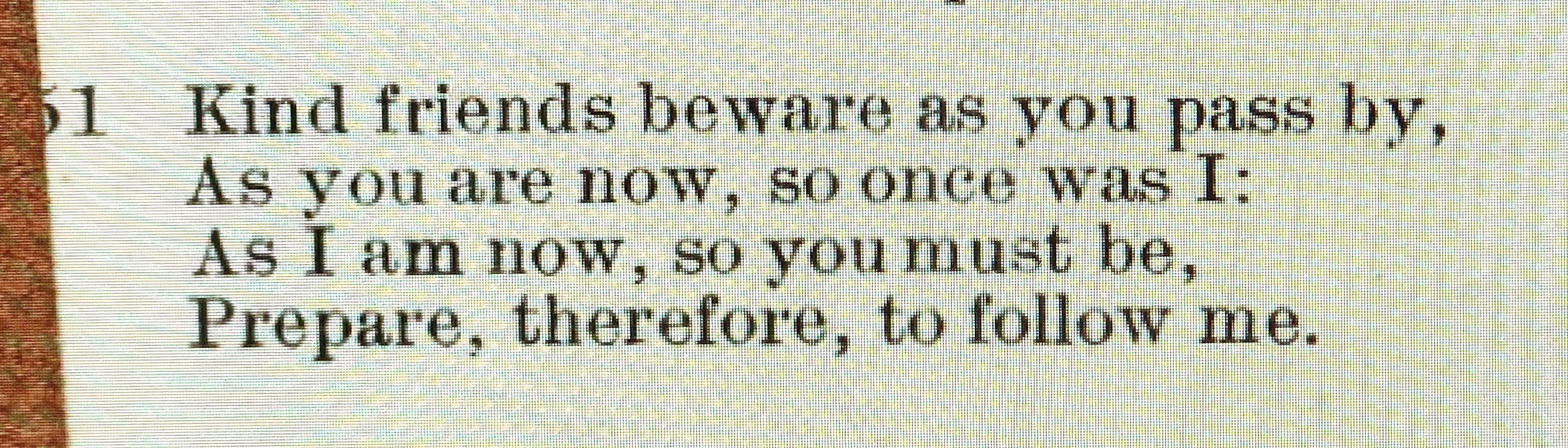
151 Kind friends beware as you pass by,
As you are now, so once was I:
As I am now, so you must be,
Prepare, therefore, to follow me.
Around 1900 the Vermont Marble Company (in Proctor) published a brochure of epitaphs. Number 339 in their brochure is the same verse that had been used on James Cassity’s stone forty years earlier:
Figure 17
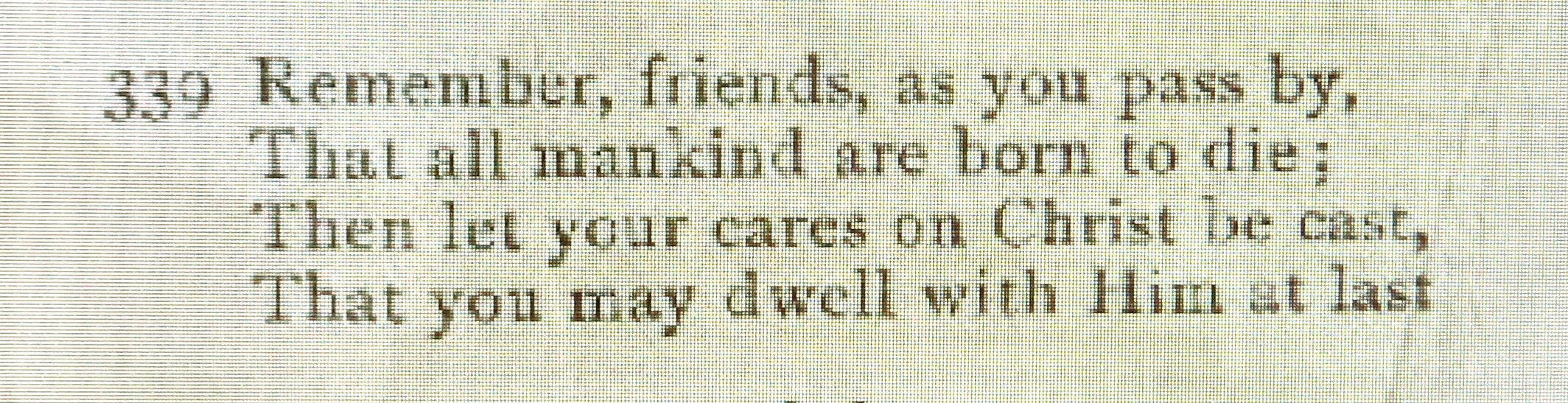
339 Remember, friends, as you pass by,
That all mankind are born to die:
Then let your cares on Christ be cast,
That you may dwell with Him at last
The Wrap-up
This is a roster of thirty-five “Remember me…” epitaphs I’ve collected. It is truly a favorite for many Maine gravestone enthusiasts, and it inspired me to write a poem to you to bring this paper to an end:
Remember this as you walk by,
Looking at stones as well as I:
If that verse you happen to see,
Please make a note, then contact me!
I’d like to expand the roster by adding stones you’ve found at your local Maine cemetery that have this special verse. Feel free to send me an email with the details (name, date, cemetery, etc.) if you find one in Maine that’s not already on the roster. Thank you!
| 1737 | Daniel & Peter Weare | As you now are, so once were we, As we now are, so you must be; Prepare to meet where we have past, Then you may dwell with us at last. |
Pioneer Cemetery, Yarmouth | Ages 6 & 3. Brothers who died the same day memorialized on a shared slate with double winged skulls |
|---|---|---|---|---|
| 1758 | Reuben Gage | Behold & see You that pass by As You are now so once was I As I am now so You must be think upon Eternitye | Pioneer Cemetery, Yarmouth | Age 35. Winged skull on slate |
| 1775 | Joal Crosby | Weep not my friends but silent be, I hope that Christ has cal’d for me; And when my Savior doth appear, Then I shall rise from sleeping here. Behold the place where now I lie, As you are now, so once was I, As I am now, you all must be, Prepare for death & follow me. | Barton-Hinds Cemetery, Winslow | Age 35. A Boston carver’s winged face on slate. This verse begins with five lines and then ends with three familiar ones… |
| 1788 | Nathaniel True | My loving friends as you pass by On my cold grave pray cast an eye. Your Sun like mine may set at noon You may yet be call’d for very soon. | Ledge Cemetery, Yarmouth | Age 39. Boston marker, tripartite tympanum, with simple soul effigy |
| 1798 | Freeman Cobb | Think on me as you pass by, As you are now, so once was I; Be wise in Time, Prepare to die. | Old Burying Ground Hampden | Age 28. Boston-made slate with winged skull |
| 1802 | Lucy (Stone) Pierce | Remember me as you pass by, For as you are so once was I; And as I am so you will be, [remaining line below grade] | Eastern Cemetery, plot H-98 | Age 29. Personified sunrise on slate; attributed to Bartlett Adams |
| 1803 | Sally Prescott | Behold and see as you pass by, As you are now, so once was I. As I am now, so you must be, Prepare for death and follow me. | Prescott Cemetery, Acton | Age 17. Urn and willow on slate (Not Adams) |
| 1803 | Mary (Coverly) Webb | Remember me as you pass by, As you are now so once was I, As I am now soon you must be, Prepare to die and follow me. | Conant Cemetery, Westbrook | Age 35. See Windham in the Past, by Samuel Dole (published 1916) page 554. Stone has been largely destroyed |
| 1809 | Susanna (LeMoyne) Young | Stop my friend, & cast an eye, As you are now, so once was I, As I am now, so you must be, Prepare for death, & follow me. | Gray Village Cemetery | Age 76. Urn on slate from the Adams shop |
| 1809 | Ruth Young | Blooming youth, as you pass by, Remember, you are born to die; My body here, lies in the dust, In hopes to rise, among the just. | Old Burying Ground Hampden | Age 14. Urn and willow on slate (Not Adams) |
| 1812 | Thomas Pennell | My loving friends, as you pass by On my cold grave pray cast an eye; Remember as I am so you must be Prepare to die & follow me. | First Parish Cemetery, Brunswick | Age 74. Urn with bunting on slate by Bartlett Adams and likely lettered by Alvan Washburn |
| 1813 | Caroline Tebbets | Remember Reader you must die, And turn to dust as well as I. | Laurel Hill, Saco | Age 19. Urn with bunting on slate by Bartlett Adams. The stone was moved to Laurel Hill and set in concrete but spacing suggests this may just be two lines |
| 1816 | Reuben Keazer | Stop all my friends as you pass by, As you are now so once was I, As I am now soon you must be, Therefore prepare to follow me. | Chebeague Island Golf Course Cemetery (private) | Age 39. Backdated square-top purple slate |
| 1818 | Gideon Ramsdell | My children dear as you pass by, On my cold clay pray cast an eye; As I am now so you must be, Prepare to die and follow me. | Gray Village Cemetery | Age 74. Heavily decorated slate by Elias Washburn |
| 1819 | Ebenezer Emery | Remember me as you pass by As you are now so once was I As I am now so you must be Prepare for death and follow me | Greenwood Cemetery, Biddeford | Age 73. Urn and willow by Elias Washburn on slate |
| 1820 | Sarah C. Baker | Stop blooming youth as you pass by On my cold grave pray cast an eye; As I am now, so you must be Prepare to die & follow me. | Fort Hill Cemetery, Gorham | Age 20. Urn and willow on slate |
| 1821 | Sarah Clark | “Remember me as you pass by, As you are now so once was I As I am now so you must be, Prepare to die and follow me” | Hillside Cemetery Eastport | Age 25. Urn and willow on slate |
| 1822 | Chloe (Bradford) Starboard/ Starbird | Remember me as you pass by, As you are now so ————; [remaining lines below grade] | Eastern Cemetery, plot K-123 | Age 59. Surname on marker is spelled Starboard, but other records use Starbird. Urn and willow on slate that was lettered by Bartlett Adams |
| 1823 | Margaret Wiswell | Remember me as you pass by, As you are now so once was I; And as I am, so you must be, Prepare for death & follow me. | Eastern Cemetery, plot I-174 | Age 18. Fragment of slate spells her name as Magaret instead of Margaret. Lettered by Bartlett Adams |
| 1826 | Nathan Lord | Behold and see as you pass by, As you are now, so once was I; As I am now so you must be, Prepare for death and follow me. | Lord Cemetery, Westbrook | Age 79. Square top slate, undecorated |
| 1832 | Josiah Starling | Remember me as you pass by, As you are now so once was I, As I am now so you must be, Prepare for death and follow me. | Monhegan Cemetery | Age 72. Marble |
| 1833 | David Marston | Ye blooming friends as you pass by, As you are now so once was I; [remaining lines below grade] | Walnut Hill Cemetery, North Yarmouth | Age 21. Urn and willow on slate |
| 1834 | Samuel Lane | Remember me as you pass by, As you are now so once was I, As I am now so you must be, Prepare for death and follow me. | Peare Cemetery, Greene | Age 48. Urn and willow on slate |
| 1836 | Enoch Littlefield | Remember me as you pass by As you are now so once was I As I am now so you must be Prepare for death and follow me | Chebeague Island Littlefield Family Cemetery (private) | Age 18. Urn with heart and willow on slate. This stone does not appear on Find A Grave (on private land) |
| 1837 | John Holland | Remember friends, as you pass by, As you are now, so once was I, As I am now, so you must be, Prepare for death and follow me. | Eastern Cemetery, plot A-11-19 | Age 37. Urn and willow on slate |
| 1838 | Martha Hatch | Stop my friends as you pass by, As you are now so once was I, As I am now so you must be, Prepare for death and follow me. | Eastern Cemetery, plot J-186 | Age 41. Listed on stone as Miss and daughter of Capt. Walter Hatch. Top right sheared off, marker reset and cleaned. (Very good photo of the verse) |
| 1838 | Daniel G. Nason | Stop youth and read as you pass by As you are now, so once was I. As I am now, so you must be Prepare for death and follow me. | Old Fields Cemetery, South Berwick | Age 29. Cause of death cholera. Urn and willow on slate |
| 1840 | Joshua Freeman | Stop here my friends and cast an eye, As you are now so once was I; As I am now so must you be, Prepare for death and follow me | Eastern Cemetery, plot C-168 | Age 76. Urn and willow on slate |
| 1842 | Huldah S. Card | My youthful friends, as you pass by, As you are now, so once was I, As I am now, so you must be, Prepare to die, and follow me. | Partridge Cemetery, Woolwich | Age 20. Marble marker |
| 1844 | Ester Hutchins | Stranger as you pass by As you are now so once was I [As I am now so you must be So prepare to follow me] | Hillcrest Cemetery, Stow | Age 24. Square top slate with urn and willow. Verse needs verification since wording seems off. Poor photo shows only two lines, but Find A Grave listing gives all four… |
| 1844 | Eunice Johnson | Remember me as you pass by, So once was I as you are now; As I am now so you must be, Prepare for death and follow me. | Bowie Cemetery, North Yarmouth | Age 21. This one is mentioned in Early Gravestones, page 37. OUTLIER for misplacement of rhyming words! Willow on slate |
| 1849 | Lorenzo Bailey | Behold, young friends, as you pass by, As you are now, so once was I; As I am now soon you must be, Prepare for death and follow me. | Old Village Cemetery Canaan | Age 18. Marble marker with good photo of verse on Find A Grave |
| 1853 | Ruth Arthurs | Attend and look as you pass by, As you are now so once was I; [remaining lines below grade] | Mattawamkeag Cemetery | Age 32. Undecorated marble |
| 1861 | Rachel L. Knowles | “Remember me as you pass by, As you are now so once was I As I am now so you must be, Prepare to die and follow me” | Peare Cemetery, Greene | Age 16. Undecorated marble |
| 1863 | James Cassity | Remember friends as you pass by, That all mankind are born to die; Then let your cares on Christ be cast, That you may dwell with him at last. | Calvary Cemetery, South Portland, plot D OC-7-2 | Age 44. Large marble decorated with crucifixion scene. Stone matches that of his brother. This version is closest to the one in the Vermont Marble Company catalog, #339 |
References
1 See Andrew Libby’s stone at Black Point Cemetery in Scarborough. He died 1773. back to text 1
2 The Burgess book was published in London by Lutterworth Press. back to text 2
3 One was a 2010 blogger who referenced the 1850 New England Historical and Genealogical Register. The blog, vastpublicindifference.com, has been inactive since 2013. The second source is an article by Avon Neal entitled “Graven Images” from American Heritage, the journal published by the National Historical Society (August 1970, Volume 21, Issue 5). back to text 3
4 The full title of Cary’s book is A Collection of Epitaphs, Suitable for Monumental Inscriptions, from Approved Authors. (1865). Stereotyped and printed in Boston by Dakin and Metcalf. back to text 4
5 The full title of Simpson’s book is A Collection of Curious, Interesting, & Facetious Epitaphs, Monumental Inscriptions, Etc., Etc. (1853). back to text 5
6 The full title of Norfolk’s book is Gleanings in Graveyards: A Collection of Curious Epitaphs, Collated, Complied, and Edited… The publisher in London was John Russell Smith (1866). back to text 6
7 The full title is Curious Epitaphs Collected from the Graveyards of Great Britain and Ireland. With Biographical, Genealogical, and Historical Notes. London: Hamilton, Adams, and Co. back to text 7
8 The full title is A Collection of Epitaphs and Inscriptions, Interesting Either from Historical Associations or Quaintness of Wording. Published in Edinburgh 1885, and privately printed. back to text 8